
When I was younger, my main ambition in life was to own a dog.
Unfortunately, my parents were reluctant to buy one because they both worked long hours and thought that looking after a dog would be impractical.
When I was seven, I decided to take matters into my own hands and actively wrote to Santa asking for a dog.
At the time, I thought that I was being really crafty .
I thought that I had devised a cunning plan to outwit my parents by going behind their backs in order to obtain what they had previously denied me. As a child, I had a very intense and vivid imagination and invested heavily in fantasies and delusions.
As a result, I had complete faith in Santa’s ability to provide, not only free 24-hour delivery of a live animal, but also a complimentary kennel construction and installation service.
I was therefore slightly disappointed when all that I received on Christmas Day was a DVD of Disney’s ‘101 Dalmatians’.
At this point, any sensible child would have learned to monitor their expectations and set their sights a bit lower.
Not me.
In fact, the following year, I decided to up the ante. The prospect of having a magical flying unicorn excited me – not only would it be an efficient mode of transport but it could also act as a symbol of my inherent coolness which I could use to improve my social status on the playground.
Christmas day arrived and I rushed downstairs, only to find a distinctly non-unicorn sized package waiting for me under the tree.
Attached to the package was the following note: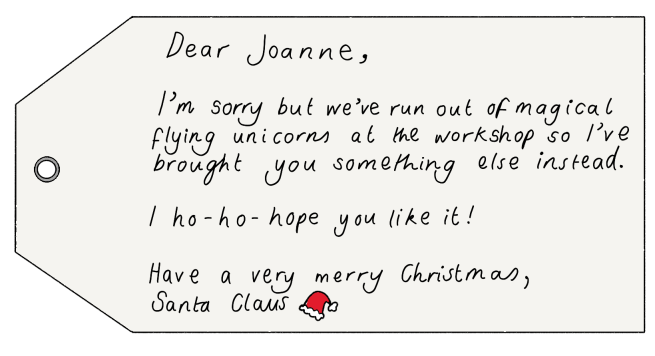 Inside the package was a ‘My Little Pony’.
I’m not going to lie – the ‘My Little Pony’ was a MASSIVE downgrade from a magical flying unicorn.
I told my Dad that I ‘ho-ho-hoped Santa was very disappointed with himself’ but apparently this was ‘slightly out of tune with the spirit of Christmas’ so I brushed the hair of my ‘My Little Pony’ and tried very hard to look as if look like the process of doing so filled me with festive merriment.
Over the course of the following year, I discovered the Harry Potter books.
My favourite Harry Potter book was ‘Harry Potter and the Prisoner of Askaban’, mostly because I was borderline obsessed with Buckbeak the Hippogriff.
As a far as I was concerned, a hippogriff was a cooler, edgier version of a magical flying unicorn.
I decided that I wanted to go to Hogwarts and buy Buckbeak off Hagrid.
My dad once told me that if you want to get anywhere in life you have to learn to work your contacts so, that year, I wrote a letter to Santa asking him for a letter to Hogwarts. At the time, I thought that relying on a fictional character to help me escape into a fictional world was a completely legitimate, logistically-sound plan.
However, on Christmas day, I was once again disappointed when I received a copy of ‘Harry Potter and the Goblet of Fire’ along with a note that explained that all I needed to go to Hogwarts was my ‘imagination’.
By this point, I was getting quite frustrated with Santa.
However, despite repeated disappointments over the course of several years, I still fervently believed that he was real.
In fact, my brother, who was two years younger than me, discovered the truth about Santa before I did.
 Evidently, I thought that Santa was having some sort of confidence crisis and that my pep talk would provide him with the self-esteem boost to cement his place in concrete reality.
I was quite upset when I didn’t receive a reply.
I saw it as a personal rejection.
After all, I had made the effort to write a letter to Santa and, even if he wasn’t real, the least he could do was write back to me to confirm his lack of existence.
I obviously couldn’t wrap my head around the idea that this lack of existence may have somewhat impaired his ability to reply to me – in fact, in order for him to reply to me he would have had to sent me a message from an alternate fictional dimension, something that would have essentially involved defying the laws of existence.
Nowadays, I have a better understanding of the boundaries between fiction and reality.
That being said, a small part of me still kind of believes Santa Claus is real.
However, I know that if he does exist, he is probably struggling to update his business model in order to remain competitive in an overly saturated, technologically-advanced modern market.
 If you enjoyed this post, feel free to check out some of my other posts. For more blog posts and drawings, you can also follow me on Facebook, Twitter and Instagram.

 Some Words That Say What I Think